Book 1 Lesson 3 — sira kaminan (Family Members)
sira kaminan | Family Members
When they arrive at the house of si nan Maoyong (Sn), Sompo's (So) aunt, she introduces the family, which includes the grandmother, the husband, and two sons si Maoyong (Mo) and Mateneng (Mt).
Readings
Good morning, grandpa, grandma, auntie, uncle, cousins!
Good morning, my grandson.
Good morning, child.
Good morning, younger cousin.
Good morning, older cousin.
Did you not go into the mountains yet?
We just finished breakfast, so we are resting a little.
Hello, everyone!
This is my college classmate. I invited her to come tour our island.
Hello, I'm Sompo's aunt. This is my mother-in-law, my father-in-law, and this is my husband.
Hello, I'm Maoyong, and I teach the Yami language in the local junior high school.
I'm si Mateneng, and I work in the local township office.
Please, have a seat. Have you eaten breakfast yet? Do you want some breakfast?
No, thank you! We are full.
Grammar | sira kaminan (Family Members)
(1) The position of na and pa
In general, an enclitic pronoun follows a verb, but if a monosyllabic adverb (na “already”, pa “still, again”) occurs in the sentence, na or pa will be ordered after the enclitic pronoun, as in (1). If the enclitic pronoun is placed at the beginning of the sentence to express an event that is progressive or just happened, na or pa can still follow the pronoun, as in (2) and (3), or stay in the original position, as shown in (4) and (5). rana “already” is the long form of na.
Do you want some breakfast?
2. kamo pa ji nimangay do takey?
Did you not go into the mountains yet?
3. kamo na niromiag?
Have you eaten breakfast yet?
4. namen mamahamaha pa, ta namen kateyka pa nikoman.
We just finished breakfast, so we are resting a little.
5. ciaha, ta namen mabsoy rana.
No, thank you. We are full.
(2) Word order in the topicalized construction with am
The basic word order in Yami is a Predicate followed by a Subject. However, to emphasize the subject, it is common to use the topicalized construction, which refers to the raising of the subject to the beginning of the sentence as the topic, followed by a Topic marker am. In the topicalized construction, the raised subject pronoun should use a free form, as illustrated in (6) and (7).
This is my mother-in-law, my father-in-law, and this is my husband.
7. yaken am, si Mateneng ko.
I'm si Mateneng.
(3) The deictics o ri, o ya
In Yami, there is a set of deictics (see Table 3) to show the distance (far or near) of the noun phrases in relation to the speaker. The so-called “near” refers to something that is now, visible, known, close to, factive, or alive; on the other hand, the so-called “far” refers to something that is past, invisible, unknown, generic, hypothetical, or dead. The distance of deictics is closely related to personal pronouns (the first, second, and third person pronouns).
The following sentence (8) illustrates that the free form of the deictic can be used in a topicalized construction in which the subject is raised, but an enclitic form is placed at the end of the noun phrase. By the use of the deictic ya, one can tell the parents-in-law are close to the speaker, while the husband is next to the father-in-law.
This is my mother-in-law, my father-in-law, and this is my husband.
As shown in (9), the use of jito indicates that the speaker asks the interlocutor to sit a little farther from where they are. The location marker do is deleted here.
Please, have a seat.
Activities | sira kaminan (Family Members)
- Students should role play as members of a large family, relatives and friends. Greet each other, and ask each member of the family to take turns introducing family members.
- Ask each role playing student to take turns asking friends to sit down, whether they have eaten, and similar questions.
Demonstrate | sira kaminan (Family Members)
(1)Family introduction
oya am, si ina, oya am, si ama,
o ito am, si kaka, o ito am, si wari,
o ito am, si akay.
Hello, I am si Magaga. This is my mother, my father, this is my older brother, that is my younger sister, and that is my grandfather.
(2)Inviting to sit and asking about meals
Please have a seat. Have you eaten breakfast yet?
nohon, ko na ji niromiag.
Yes, I have eaten breakfast.
2. romiag ka pa an? (= koman)
Why don’t you have some more?
ciaha, ta ko na mabsoy.
It is ok, I am full.
3. ji ka makasi (ji ka makarilaw).
Don’t force yourself. [poor guy]
ciaha,
It’s ok.
Exercise | sira kaminan (Family Members)
(1) Family positions + deictics
Each student should draw a picture of where each member of the family is currently located, and then practice using deictics (i.e., this, that, etc.) to introduce family members and their work and personality.
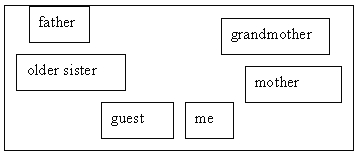
This is my mother.
si akes o ito.
That is my grandmother.
o ito am, si ama, ya mivazay do Wuri.
That is my father; he works in Wuri.
o ito am si kaka, ya mivazay do Taipei.
That is my older sister; she works in Taipei.
yaken am, si Magaga ko, ko pa mivatvatek do Providence University.
I am si Magaga, and I am studying at Providence University.
ya mateneng si ina manonotong.
My mother cooks very well.
ya magága si akes.
My grandmother is very optimistic.
ya apia tao si kaka.
Isn’t my sister pretty?
(2) Pair work: asking about family background
With two students per group, exchange family drawings, and ask each other about family background.