Book 1 Lesson 5 — mangay do gako (Visiting a School)
mangay do gako | Visiting a school
Maoyong (Mo) was waiting at school to introduce Sompo (So) and Masaray (Ma) to the school.
Readings
Is this your school? It’s huge!
Oh, there are a lot of people playing basketball.
They have a break right now, so they are playing basketball.
Why are some of them so tall?
Some of them are high school students.
Oh, there is a high school here too!
Where is your classroom for teaching the Yami language?
It is over there, next to the carving classroom.
How many teachers does this school have?
Twenty.
This is my classroom for the Yami language.
Not bad. Your school has all the facilities it needs.
Children now are much better off than we were back then.
Grammar | mangay do gako (Visiting a School)
(1) Existential sentence
The nominal complement of an existential verb, i.e., mian “have, exist” and abo “no, not exist”, is preceded by the Oblique marker so if it is indefinite. If the nominal complement is definite, it is preceded by the Nominative marker o. For example:
There is a senior high school here. (a senior high school)
2. ya mian do vahay da o mavakes.
The woman is at home.
3. ya abo so kanen.
There is no food.
4. ya abo o kanen na.
He doesn’t have any food.
5. ya apía o gako nio, ya abo o ya ji ngiángian.
Your school is very good, because it is equipped with everything.
In Example (5), ngia-ngian is the inflected form of the verb root ian after the auxiliary ji “negative”. The root ian begins with a vowel, thus ng is attached to ian to form ngian.
(2) Reduplication
Yami stems can be reduplicated to express plurality or comparatives. In the following example, makakárang “all very tall (plural)” is formed by reduplicating the syllable ka of the stem makarang “high”:
Why are some of them very tall?
In the following example, ngia-ngian is formed by reduplicating ngia of the stem without the coda n:
Your school is very good, because it is equipped with everything.
In the following example, apiapia “better” is formed by reduplicating the whole stem pia and adding a- word-initially:
Nowadays children are better off than we were.
In the following example, pa-pira “how many (people, plural)” is formed by reduplicating the initial consonant p and adding a vowel a:
How many teachers are there in your school?
(3) Transitive verb suffix -an “location”
Since the transitive verb with the suffix -an refers to a location, the Patient must be the location. In the following example, the Patient of the verb pangananao-an “the place where teaching takes place” is wájin “there”:
Where is your Yami language classroom? (The place where you teach the Yami language.)
In the following example, the Object of the transitive verb piveyvatek-an “the place where they regularly carve things” is the fronted noun phrase o katangked na ori “next door”:
Next door is their handicraft classroom. (The place where they regularly carve things.)
(4) Word order
In the previous lessons, we have talked about the basic word order in Yami, which is a Predicate followed by a Subject. Moreover, the Subject contains either a noun phrase or a nominalized clause.
Your school is so good.
13. ya aro o ya mibozo.
There are many people playing basketball there.
14. ya abo o ya ji ngiá-ngian.
They have everything (lit. there is nothing that is not there).
The Predicate can consist of a noun phrase. The Nominative case marker o before a noun phrase or a nominalized construction sometimes can be omitted, as illustrated in (15)–(16).
This is your school.
16. o ri da ipibozo.
This is the reason why they are playing ball.
Activities | mangay do gako (Visiting a School)
- With a map of the middle/high school on Orchid Island provided by the teacher, students take turns asking the teacher about the places in the school that they want to go to. Then do the same activity in groups of two.
- With a college campus map provided by the teacher that includes the number of teachers in each major field, students should take turns asking about the school buildings they want to visit and the number of teachers in a certain major field.
- Students should compare former teachers, students, friends, or children (looks, personality, height, weight, and intelligence), or compare a classroom and its facilities.
Demonstrate | mangay do gako (Visiting a School)
(1)Asking directions in a middle/high school
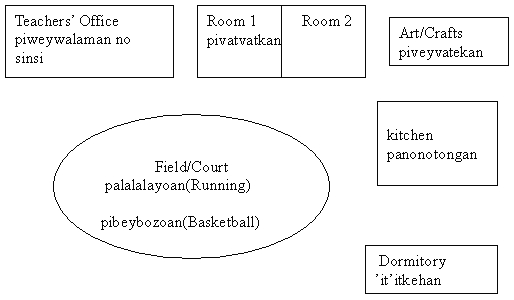
Where is the classroom for teaching Yami?
B: o ito, do ya mananavak ang.
There, the one in the middle.
A: wájin o da piveyvatekan?
Where is their art/crafts room?
B: ori do kawanan rana.
The one on the far right.
(2)College campus map and number of teachers
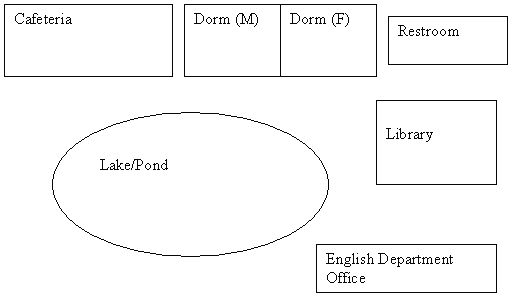
Where is the cafeteria?
B: o ito, do kaozi rana ang.
There, the one on the far left.
A: ko mangay do kareyan, mo katenngan na yanan no kareyan?
I want to go to the restroom. Do you know where the restroom is?
B: do kawanan rana ori am ori.
It is that one on the far right.
A: kamo papira a sinsi do gako?
How many teachers does your school have?
B: namen atlo a ngernan.
We have thirty teachers.
A: sia papira o ya mo pivatvateken?
How many students do you have?
B: sia lalima so ikasikatlo.
There are twenty-five.
(3)Comparing students, teachers, and facilities
Students now are all growing to be very tall.
B: sia matatatava o kakanakan siciaikoa ya a ka niamen nokakoa.
Children now are fatter than we were before.
C: sia mateteneng o kanakan siciaikoa ya,
Children now are all very smart.
D: sia pipía tao o sisin da.
Their teachers are all very beautiful.
Exercise | mangay do gako (Visiting a School)
(1)Describing locations
Students should choose a picture or map of a school and describe the location of a major place (for example, the classroom, office, library, cafeteria, or playground).
(2)Comparing people or events
Students should choose two people or events, draw them, compare the outcome, and write one or two sentences about the comparison.
(3)Vocabulary review with flashcards
Students should review the vocabulary from Chapters One through Five and make flashcards. Practice with them several times, and be able to write the words without looking. Ask a family member, friend, or classmate to test you.
(4)Listening and reading practice
Listen to the recordings of the five lessons several times, paying attention to the stress and intonation patterns. After each sentence, stop and repeat the sentence. Also, read it out loud. Finally, record your best reading and play it for the teacher and classmates.