Book 1 Lesson 8 — ili (At the Village)
ili | At the village
Sompo (So) and Masaray (Ma) ride a motorcycle toward Jiraralay.
Readings
Let’s take a car to Jiraralay.
I have been to three different villages now. What villages have I still not visited?
There are still three villages left: Imaorod, Ivalino, and Iranmilek.
Oh, are those structures that go deep into the ground their houses?
Yes, that is the traditional Yami house.
Isn’t it hot to sleep in there?
When it is hot, you can sleep on the porch or in the workhouse.
It is cool on the porch, and there is a good view.
Oh, it’s raining. What do we do?
We can spend the night here.
Ok, let’s go find Mangday and spend the night with him.
Grammar | ili (At the Village)
(1) Word order
The Subject is almost always introduced with the Nominative marker o, followed by a noun phrase (Examples 1 and 4) or a nominalized clause (Examples 2 and 3). The Predicate can be either verbal (Example 1) or nominal (Examples 2–4).
In a noun phrase, the modified noun can be placed at the end, preceded by all the modifiers. Alternatively, the modified noun can be surrounded by modifiers connected with the linker a. Generally, the head noun is followed by a pronoun or a deictic and preceded by other constituents in a noun phrase.
“I have been to three different villages now. (lit. The village I have been to are three.)”
2. [ikongo a ili pa] [o ya ko ji niangayan?]
“What villages have I still not visited?”
3. [vahay da] [o ya marahem ito?]
“Are those structures that go deep into the ground their houses?”
4. [o ri] [o ngongyod a vahay namen a tao]
“That is the traditional Yami house.”
(2) The inflection after auxiliary ji and to
The verb inflections after auxiliary ji have been discussed in the previous lessons. Except for perfective verbs, such as ji niangayan “have not visited” (Example 2 above), all verbs must undergo inflection after the auxiliary ji. The verb inflection paradigm after the auxiliary to is the same as that of ji.
The inflected form of the stative verb ma-nnget “hot” is ji ánnget “not hot”; the prefix ma- changes to a-, as shown in Example 5. The inflected form of a dynamic verb root beginning with a vowel has ng- added to it. Thus the inflection of ian “on, in” is ji ngian (Example 6), and the inflection of isan “stay for the night” is to ngisan (Example 7).
“Isn’t it hot to sleep in there?”
6. no mannget am, ya ji ngian so tagakal ito, aka no makarang a ‘itkehan.
“When it is hot, you can sleep on the porch or in the workhouse.”
7. to ta rana ngisan do jia an?
“Let’s stay here for the night.”
The inflections of dynamic intransitive verbs are shown in Table 9.
| Stem type | Base form | Changed form |
|---|---|---|
| [+alveolar] | salap | nalap ‘fly’ |
| [+palatal] | ciowciow | niowciow ‘scare away, chase’ |
| [+labial] | panta | manta ‘give’ |
| [+velar] | kan | ngan ‘eat’ |
| [+vocalic] | isan | ngisan ‘stay overnight’ |
| ai | ngai ‘come’ | |
| oli | ngoli ‘come home, return’ |
(3) ka- “and then…”
When several events/actions are in order, the second and the following events/actions are coded with the sequential verb prefix ka- “and then…”. The Agent is Genitive, for example ta “we”, mo “you”. Other discussions on the ka- verbs can be found in Lesson 10.
“Ok, let’s go find Mangday and spend the night there.”
9. toroan jiaken a ka-ngay mo rana do pantaw.
“Hand it in, and then you can leave.”
Activities | ili (At the Village)
- The teacher should provide the students with a map of Orchid Island, describe the location of the different villages, the natural terrain, and the location of major landmarks (such as the school, the town hall, the farmers’ bank, TaiPower, church, Lan-En Foundation, the hotel, and cottages), and also provide pictures of the traditional buildings, work houses, and outdoor porches.
- Students should ask each other about which villages or landmarks on Orchid Island they have been to, and which they haven’t been to.
- Role play: It is raining, and two tourists and a Yami guide are wondering which option is better for lodging. Consider the likelihood of each possible option.
Demonstrate | ili (At the Village)
(1)Map of Orchid Island & village layout
The teacher should provide the students with a map of Orchid Island, describe the location of the different villages, the natural terrain, and the location of major landmarks (such as the school, the town hall, the farmers’ bank, TaiPower, church, Lan-En Foundation, the hotel, and cottages), and also provide pictures of the traditional buildings, work houses, and outdoor porches.
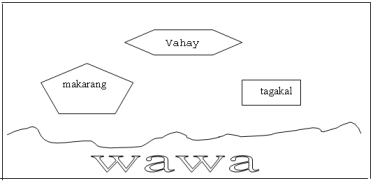
The work house (tall house) is on the left, the porch is on the right, the main house is in the middle, and our village (house) faces the ocean.
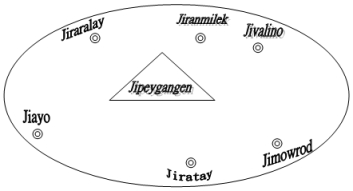
o ya anem a ka ili am: Jiratay, Jimowrod, Jivalino, Jiranmilek, Jiraralay, Jiayo,
nimakarang na tokon do pongso namen am Jipeygangen.
This is our island. Our island has six villages. The six villages are: Jiratay, Jimowrod, Jivalino, Jiranmilek, Jiraralay, and Jiayo. The tallest mountain on our island is Jipeygangen.
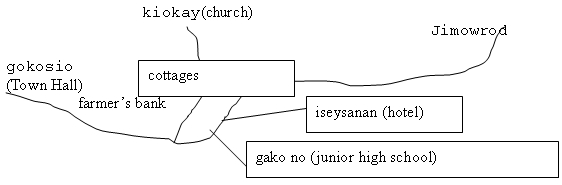
This is Jiayo. In Jiayo, there is a township office, a farmer's bank, a local junior high school, a hotel, and cottages. The one on the very top is the Assembly of God church.
(2)Have you been there? Villages & landmarks
Students should ask each other about which villages or landmarks on Orchid Island they have been to, and which they haven’t been to.
I have been to Jiraralay and Jiayo. Which villages have I not been to yet?
2. do Jivalino a ka Jiranmilek.
Jivalino and Jiranmilek.
(3)Role play: choosing where to stay when it rains
Role play: It is raining, and two tourists and a Yami guide are wondering which option is better for lodging. Consider the likelihood of each of the following.
Oh, it is raining. Now what?
2. to ta rana ngísan do jia an?
Let us stay overnight here, ok?
3. nohon; mi ta kalaen si Mangday a kaisan ta do dang an.
Sure. Let’s go find si Mangday and spend the night there.
Exercise | ili (At the Village)
(1)Reading about architecture
Read about the architecture of Orchid Island. Choose one type of building (e.g. traditional house, work house or porch) and draw a picture of it. Label each of the parts inside.
(2)Space & daily life
Draw the traditional resting place of the Yami (e.g. traditional house, work house, porch) and the position of each in relation to another, and write about what they usually do in those areas.
(3)Observing noun phrases
In the reading for this chapter, nouns appear very often. Can you figure out how Yami nouns are constructed? Can you see which ones are nouns? If there are other modifiers that modify the major head noun of a noun phrase, what is the order that they are written? If there are over two nouns strung together with “and”, how is it written in Yami?
(4)Describing classmates & seating
Write down the names of the people who sit next to you on the left and right as well as across from you. Describe the students in your class, including who is the tallest, the shortest, etc.
1. do kaozi ko am si Mawawa, do kawanan ko am si Mangarilaw, ya mian do kananmaen ko si Miyowyaw,
2. oya am, pivatvatekan namen, namen nanem a mivatvatek, o ngaran namen am:
si Mawawa, si Mangarilaw, si Mapamiying, si Jiateneng, si Miyowyaw, si Mangamizing, a ka ni Masaray, nimakarang na si Miyowyaw, nimaveveh na si Mawawa.