Book 2 Lesson 1 — kakawan (Weather)
kakawan | Weather
Because it is hot and humid, Sompo (So) and Masaray (Ma) went swimming together. Masaray finally personally experienced the rapid weather changes of Orchid Island.
Readings
Ah, the weather is so humid.
Let’s go swimming.
I didn't bring my swimsuit.
You can just wear your shorts.
The clouds are very dark over there. Oh, there was lightning — let's go.
That's strange — there's thunder. Is there a typhoon coming?
Hurry, let's run, or else the lightning might strike us!
Ah, it's pouring! Fortunately, we're home already.
Yeah.
Look at Little Orchid Island — it's sunny on one side and raining on the other.
Yeah, the weather on Orchid Island is strange.
Hey, look — there's a rainbow over the ocean!
Yes! It's so beautiful.
Grammar | kakawan (Weather)
(1) Auxiliary ya
When talking about weather, the auxiliary ya is often placed at the beginning of a sentence to indicate that the event is currently happening. The auxiliary ya is grammaticalized from the deictic ya “this” or the third person singular pronoun iya “he/she/it.”
“Sigh! The weather is muggy.”
2. ya madémdem o cinalab do jito, wo, ya micicilat rana.
“It is cloudy over there. Oh, it is lightning.”
3. ya matákzes, ta ya mikadey, ya mian so kakawan ya an?
“Odd enough, it thundered. Is the typhoon coming?”
4. ya maválang a ya mikalapoto o araw.
“It is sunny and raining at the same time.”
5. ya minanangirang do wawa.
“There is a rainbow over the ocean.”
(2) Verbal affixes
Consider the derivation of the stem awawat “swimming.” In (6), the stem forms an intransitive verb with the prefix mi-, which is historically fused from -om- and pi-. The agent takes the nominative form ta “we.” In (7), the prefix i- indicates an instrument; thus i-pi-awawat refers to “something used for swimming,” i.e., a swimsuit. The pronoun ko marks possession (“my”).
“Let's go swimming.”
7. ta ko ni-mapa-lolo so i-pi-awawat ko.
“I forgot to bring my swimsuit.”
(3) Conjunction ta
The conjunction ta appearing at the beginning of a sentence or before an auxiliary expresses a meaning like “contrary to expectation,” serving as a negation of the proposition that follows.
“I forgot to bring my swimsuit.” (lit. “Where would I have brought a swimsuit?”)
Additionally, ta can also mean “because,” as in:
“Odd enough, it thundered.”
10. key, malalayo ta, ta to na anao yaten no cicilat.
“Hurry, let's run, or lightning will hit us.”
11. ay, ráko a cimoy, ayoy ta makaranes ta na.
“My goodness! It's raining heavily. Luckily we're already home.”
(4) Causative construction
Besides the causative prefix pa- introduced in Volume 1, this lesson includes the causative prefix mapa-, attached directly to the root. The form mapa-lolo means “to cause to follow.”
“I forgot to bring my swimsuit.”
(5) Verb inflection after the auxiliary to
As discussed in Volume 1, verb inflection following to is identical to that after ji. In (13), mi-abtan is derived from pi-abtan “to wear shorts.” In (14), a-nao derives from the stative verb ma-nao, used here transitively; thus ma- → a-.
“You just need to wear shorts.”
14. key, malalayo ta, ta to na a-nao yaten no cicilat.
“Hurry up, let's run, or lightning will hit us.”
(6) Adverb apia (“good”)
The word apia functions as an adverb modifying a following transitive verb, connected through the linker a. Because apia ends in a, the linker may be phonetically fused and omitted. The transitive verb can also be nominalized, as seen in (16), where kanen means “food.” Such fluidity between nouns and verbs is typical of Yami and other Austronesian languages.
“It is beautiful to see.”
16. apia (a) kanen o wakay.
“Sweet potato is delicious!”
Demonstrate | kakawan (Weather)
(1) Talking about hometown weather
Ask each student to talk about their hometown’s weather in turn. Teacher can provide a model and necessary vocabulary to help the students express their ideas.
apía o kakawan do Taichung, The weather in Taichung is good.
ji árekmeh a, ji ánnget, It is neither too cold nor too hot.
manao o kakawan so kehtehteng, The temperature is just about right.
apéreh o angin do teyteyka, There aren’t too many typhoons in the summer.
ji ácimocimoyin do amian. It rarely rains in the winter.
maráhet o kakawan do Taipei. The weather in Taipei is not good.
masánib a mikangin do teyteyka, There are many typhoons in the summer.
macimocimóyin do amian. It often rains in the winter.
teymánnget do Kaohsiung, mátdong pa a. The weather is too hot and muggy in Kaohsiung.
(2) Role play — thunderstorm while swimming
A: ya mikedekedep rana, apia ya? It is getting dark. What should we do?
B: moli ta na, ta ya kmi macimocímoy. Let’s go home. It seems that it is going to rain.
(Rain / Thunder)
A: wow, ya mikadey! Wow, thunder!
(Lightning)
B: key, ta ya micicilat, Hey, lightning!
(Sun appears)
A: ya apía rana o kakawan, The weather has turned good.
(Rainbow appears)
B: cíta pala ito, ya mirarangirang do wawa! Look! There is a rainbow over the ocean.
A: cigian, ya apía citaen! Wow, it's beautiful!
(3) Weather forecast practice
Teacher provides a model of weather forecast. Students then play the role of meteorologists. Students must pay attention to the time expressions as illustrated in Table 1.
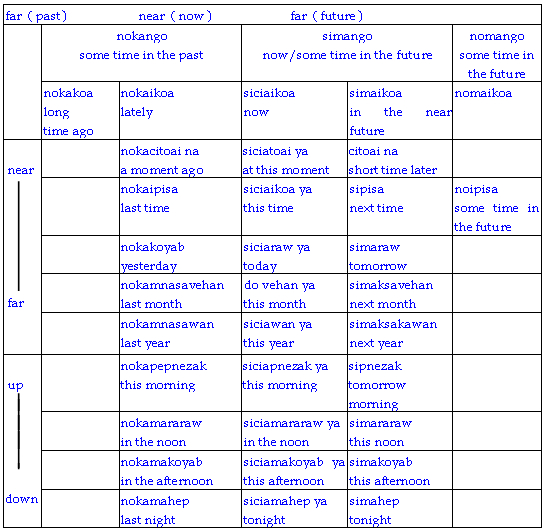
kókay kamo manga keypong, ya ko pazimanen (ipanci) o kakawan siciatoai ya, siciaraw rana am, ya apía o kakawan, ya méyna (meycicincinan) do maraw, am simakoyab am, ya macimoy a na kapikadey; simahep am, ya miparekmeh, azimanen nio an, ori o kakawan siciaraw ya, kokay kamo.
Good morning! Now for the weather report. It will be hot this morning. There will be thunderstorms in the afternoon. Please beware of the lightning. The weather is getting cooler in the evening. That's the weather for today.
Exercise | kakawan (Weather)
(1) Drawing & Weather Labeling
Ask students to draw a picture illustrating the weather changes shown in the lesson dialogue, and label each element in Yami. For example:
cinalab — cloud
cimoy — rain
mikadey — thunder
micicilat — lightning
rangirang — rainbow
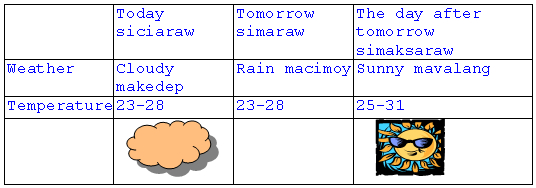
(2) Three-day Weather Forecast
Students may look up the official Orchid Island weather report (for example, the Lanyu weather station website) for the past three days, then imitate a weather reporter and create a three-day weather forecast for Orchid Island. Students should fill in the table below with weather descriptions, temperature, wind direction and speed, and precipitation probability.