Book 2 Lesson 4 | vahay no tao (Visiting a Traditional House)
vahay no tao | Visiting a Traditional House
Sompo (So) and Masaray (Ma) went to Ivalino to visit Sompo's friend, Si nan Magaga (Mg). Si nan Magaga took them to see his mother's traditional house.
Readings
It is so dark in here. I can't see you, Sompo.
I'm right here—come on!
Ow! My head—it hurts!
Keep your head low—because the entrance is very low.
Okay, I can see now.
Is this your first time entering a traditional Tao house?
Yes. Orchid Island houses and Taiwan houses are structurally different.
Of course. Because we are afraid that the typhoon may blow the house away, our traditional houses are built very deep into the ground.
Oh, I see. Doesn't it flood when it rains?
There is a gutter. Why don't you go to the porch? If you stay here, you'll be overwhelmed by the smoke.
I need to go to the bathroom. Is there no bathroom here?
Nope. I'll take you to a trash dump far away.
Grammar | vahay no tao (Visiting a Traditional House)
(1) More on ji “negation, emphasis” and its effect on verb forms
makacita “to see” is an intransitive verb (Example 1) and does not take a specific object. The negative structure ji a-cita “cannot see” (Example 2) may be analyzed as derived from the stative verb ma-cita used transitively, with the verb taking a specific object such as imo “you.”
2. ya masári o sahad, ko ji a-cita imo mo Sompo. It is so dark inside; I cannot see you, Sompo.
Example (3) ji a-niahey-an “(indeed) afraid because of…” is derived from i-ka-niahey “to be afraid because of…”. The transitive prefix i- becomes the suffix -an, and ka- changes to a-.
Examples (4)–(6) show dynamic intransitive verbs. The initial sounds of the stems undergo changes: (4) and (5) are derived from pi-angay and pi-bebneng; (6) begins with a vowel and therefore takes the prefix ng-.
5. ya ji meybebneng o ranom no ya macimoy ang? Doesn't the water accumulate when it rains?
6. ji ngian so rarahan no ranom. There is a drainage canal.
(2) More on ka- verbs
In Example (7), ka- expresses “just now; newly” and often appears with the adverb pa “only just,” forming the meaning “for the first time.” The agent appears in the genitive case.
(3) More on the transitive prefix i-
Besides expressing “to be (thus) because of…” (Example 8), the transitive prefix i- can also indicate “to move something to another location” (Example 9).
9. ji abo, y-angay ko imo do kareyan do kahasan. No, I will take you to a faraway dumping place.
(4) More on ka-…-an: “involuntarily affected by…, suddenly overtaken by…”
In Book 1, ka-cimoy-an meant “to get rained on.” In this lesson, ka-'ob-an means “to be overwhelmed by smoke” (Example 10), and ka-das-an means “to urgently need to defecate” (Example 11). All express involuntary impact or an unexpected situation.
11. ko ka-das-an, ya mian so kareyan do jia? I need to use the bathroom—is there one here?
Demonstrate | vahay no tao (Visiting a Traditional House)
(1) Dialogue practice: Asking for directions & avoiding danger
Students work in pairs and complete the following dialogues.
A: ko mapasaway, ya mian so panahetan do jia?
I want to urinate. Is there a bathroom?
B: angay do sahad.
Go inside the house.
A: ko kadasan, ya mian jia so panahetan?
I want to have a bowel movement. Is there a bathroom?
B: óri do kawanan.
Over on the right-hand side.
A: ko mangay do kareyan, wájin angayan do kareyan?
I need to go to the bathroom. Where is the bathroom?
B: ángay do teylaod no kamaligan o ito.
Go to the area below the boat houses.
A: ko kahoban, wájin angayan ko ya?
I was overwhelmed by the smoke. Where can I go?
B: ángay do tagakal a miwalam.
Take a rest on the porch.
A: ko nikacimoyan, apia o ayob ko ya a mavasa ya?
I was sprinkled by the rain. My clothes are wet; what can I do?
B: ángay do pantaw a mivalavalang a kakjit no ayob mo.
Go outside to dry in the sun. Your clothes will be dried.
(2) Role play: Inside the dark traditional house
Two students enter the traditional house. It is dark, and one person bumps his/her head on the low doorsill.
Gosh, my head—it hurts! Where are you, Masaray?
B: óya ko jia, makalógod ka, ta maciknoz ka.
I'm here! Keep your head low or you'll bump your head.
(3) Conversations: Comparing house structures
Students compare the differences between Orchid Island traditional houses and Taiwan traditional houses.
Taiwan houses and Orchid Island houses are different.
B: ikong o na pitarekan no vahay do irala a ka do ilaod?
What's the difference?
A: o vahay do ilaod am, ya to patnéka do tana;
Taiwan houses are built right on the ground;
o vahay do irala am, ya maráhem o ya nikalian jia.
Orchid Island houses are built deep into the ground.
A: o vahay no dehdeh am, ya mikapepepnetan; o vahay no tao am, ya mikatlo o sesdepan na.
Non-Yami houses have compartments; Yami houses have three entrances (levels).
(4) Oral description: Features of a traditional Yami house
Students take turns describing features of a traditional Yami house.
Orchid Island houses are built deep into the ground.
B: ya mavéveh o sesdepan.
The entrance is low.
C: ya masári do sahad.
It is very dark inside the house.
D: ya máhob do sahad na.
The inside of the house is full of smoke.
E: ya abo o panahetan (kareyan) do sahad na.
There is no bathroom inside the house.
F: ya jí mibebneng o ranom, no ya macimoy.
It will not be flooded when it rains.
Exercise | vahay no tao (Visiting a Traditional House)
(1) Writing: Comparing traditional houses
Write a short composition comparing the differences between traditional Orchid Island houses and traditional Taiwan houses. You may discuss structure, depth, layout, materials, lighting, ventilation, and cultural functions.
(2) Diagram labeling: Interior of a traditional Orchid Island house
Draw the interior structure of an Orchid Island traditional house and label each part using the correct Yami terms. Suggested reference image:
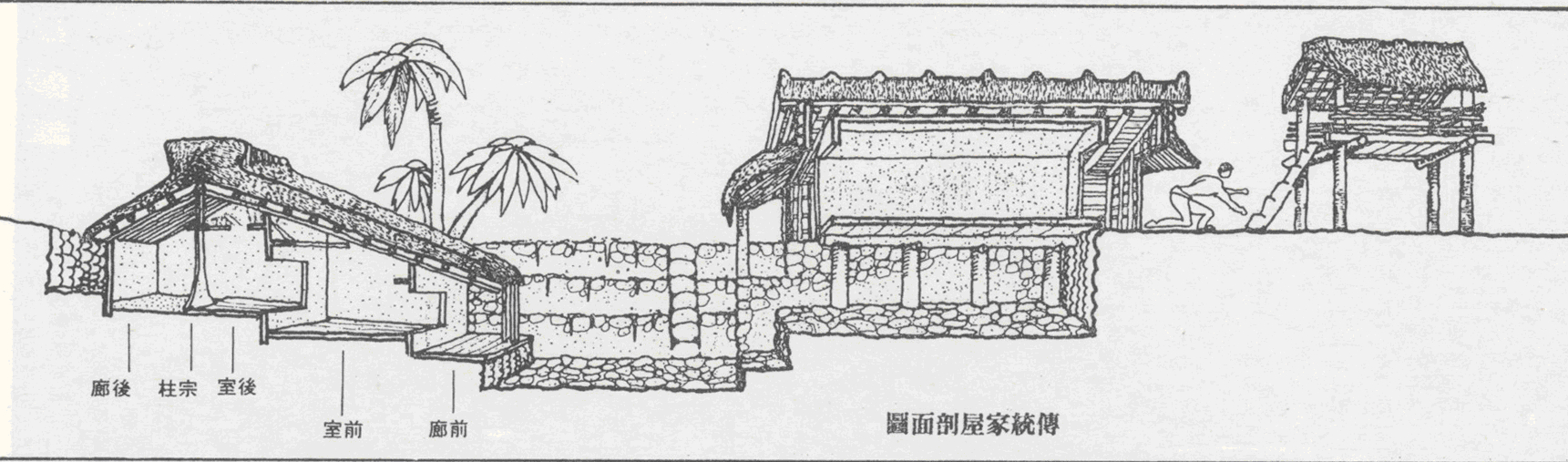
do saseyran — back porch
do sesdepan — front room / entrance area
do spanid — front porch
do avak — back room
tomok — central post, pillar
Source of illustrations: Huang Xu (1995), Yami Living Culture and Transition (in Chinese). Taipei: Dao-Xiang Publishing.
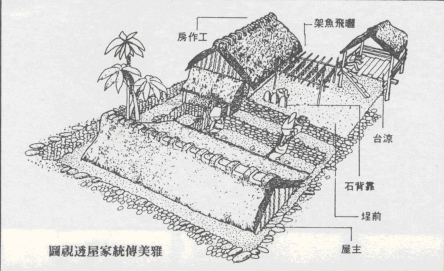
vahay — house
zazawan — shelf for drying fish
makarang — work room / storage room
pananadengan — stone for rolling taro / grinding
tagakal / lapalag — pavilion, porch
inaorod — front yard
(3) Personal project: Your house diagram
Draw the interior of your own house and try to label each room using Yami vocabulary. Include at least six rooms or areas (e.g., bedroom, bathroom, kitchen, yard, porch).