Book 2 Lesson 5 | do tagakal (On the Porch)
do tagakal | On the Porch
Si nan Magaga (Mg) took Sompo (So) and Masaray (Ma) to chat at her father (Am) and mother's (In) house.
Readings
Look, there are no clouds in the sky.
The moon is round, and there are so many stars.
Magaga's mom, can we go and talk to your mother?
Okay, but hold on—I need to take a bath first.
I can't stand si nan Manaik. She pulled up the taro I planted on the border.
Eh? What's wrong with planting there? How can she hog the whole area?
She said to me, “If you do that, you will move the border into our field.”
Mom, my sweet potatoes are big now. Can we dig them up tomorrow?
You haven't planted them long—how could they grow so fast?
Next time, let's ask the son-in-law to take us fishing.
Can I go with you?
That's taboo—women cannot go fishing with the men.
Next time, we can go catch crabs at the seaside.
Grammar | do tagakal (On the Porch)
(1) 'eza “follow, together” and its derived forms
The root 'eza “follow, accompany” may derive different verb types depending on the affixes attached.
In Example (1), pe-hza-en “cause to follow; bring someone along” is derived by adding the causative prefix pa- and the transitive suffix -en to the root. Since pe-hza-en is transitive, the agent is expressed by the genitive pronoun na “his (the son-in-law)”, and the patient is in nominative case yaken “I”.
In Example (2), ka-paci-hza “to go along with, accompany” is formed by attaching paci- “engage in, participate” to the root, then prefixing the nominalizer ka-. The agent is the genitive pronoun ko “my”, and the complement jinio “you” appears in the locative.
In Example (3), the prefix paci- changes to maci- to form an intransitive verb. The agent is nominative o mavakes “the woman”, and the complement is locative do mehakay “to a male”.
Next time, I hope my son-in-law will take me along to catch fish.
2. apia ka-paci-hza ko jinio?
Can I go with you?
3. ji makaniaw, adan a maci-hza o mavakes do mehakay a mangahahap.
It is taboo—women cannot go fishing with the men.
(2) Transitive suffix -an
The suffix -an may mark: (a) “the place where an action happens”, or (b) “the reason for (an action)”.
In Example (4), panevengan “the place where one plants” is derived from the prefix paN- plus the root, followed by -an. The form pangzan “the reason for driving someone out” contains the same paN- prefix, but here -an contributes the meaning “the reason for…”.
Ah, does it matter if we planted it there? Why did she occupy that area?
(3) The transitive suffix -en and its inflected form -a
The subjunctive / imperative form of -en is -a.
In Example (5), cíta “look!” is the imperative form of cita-en. Historically, cita-en → cita-a → the two final vowels merge → cíta.
In Example (6), botbota is the subjunctive form of botbot-en, triggered by the auxiliary todey “just; just now”.
Look over there.
6. ya teyráhet si nan Manaik ito a, na todey botbota o pinaneveng ko do piawan ta.
Manaik's mother was so mean, because she pulled out all the taros I had planted on the borderline.
(4) ka- “so…” with full reduplication
When ka- attaches to a fully reduplicated stem, it expresses “so…”.
In Example (7), kakeykeykai is derived from reduplicating the root kai twice and prefixing ka-. The agent is expressed by the genitive pronoun na “his”.
You've only planted them for such a short time—how could they grow so fast?
(5) Narrative construction: direct quotation with koan “say”
The verb koan “say” is derived from the stem koa and the transitive suffix -an. In narrative discourse, koan na “he/she said” typically appears at the end of a direct quote. The agent is genitive.
She said, “If you do that, you will move the border into our field.”
Demonstrate | do tagakal (On the Porch)
(1) Pair work: Noticing something, discussing it, complaining, and quoting speech
Two students work in pairs. First, one student draws the partner's attention to something. Then the two discuss what they observe.
A: cíta pala o angit ito, ya aboata o cinalab.
Look, there are no clouds in the sky.
B: ya mahédhed o vehan, ya aró o mata no angit.
The moon is round. There are many stars.
A: ya masazówsaw siciahep ya.
It is cool tonight.
B: ya apía miwalam do tagakal.
It feels comfortable to rest on the porch.
A: ya mapasózi si Mangday, na to ngana o kanen ko.
Mangday was a nuisance because he ate my meal.
B: ta na to ngani sia?
Why did he eat your meal?
A: “koman pa o matáva rana” koan na yaken ang.
He told me, “You are too fat to eat more.”
A: ya mapaoya si Masaray, na to nginoma o inomen ko.
Masaray was a nuisance because she drank my drink.
B: ta na to nginomi sia?
Why did she drink your drink?
A: “minom pa o matáva rana” koan na yaken ang.
She told me, “You are too fat to drink more.”
A: ya mapaoya si Miyowyaw, na to ngpa o vakong ko.
Miyowyaw was a nuisance because she took my book.
B: ta na to ngapi sia?
Why did she take your book?
A: “manita pa so vakong o mateneng rana” koan na yaken ang.
She told me, “You are too smart to read more.”
(or) “mivilang pa o mateneng rana” koan na yaken ang.
(Or: “You have enough intelligence already.”)
A: mi ko maciwalam jimo an?
I will go to your place to chat, OK?
B: nóhon, ji ka na ngai. (or: mai ka am, makong.)
Okay, just come over. (Or: Come, it's fine.)
A: mi ta maneysavat an?
Shall we go catch crabs?
B: nóhon, am apisan ko pa o ayob ko an.
Okay, but I need to wash my clothes first.
A: Magaga, mi ta mangna an.
Magaga, shall we go fishing?
B: tosia, ya ji aro o vazay ko.
No, I'm busy.
A: mi ta maciwalam ji Masaray an?
Shall we go chat at Masaray's place?
B: ya jeyngen o oo ko.
I have a headache.
(2) Game: Telephone
The first student whispers a sentence to the next student. Each student passes it on. The final student says aloud what they heard, and the class compares it with the original.
Teacher says, “You come here.”
2. koan na ni Masaray am: “mi ka mitkeh” koan na.
Masaray reports, “You go to sleep.”
(3) Game: Simon Says
One student acts as the “teacher.” Students must follow a command only if it begins with “Teacher says…”. If they follow a command without this phrase, they are eliminated.
Teacher says, “Sit down.”
maniring o sinsi ta am: “patanek o lima mo”
Teacher says, “Raise your hand.”
maniring am: “omalam ka”
Walk. (No “teacher says”—do NOT follow.)
maniring am: “mitotoklay ka”
Jump. (Do NOT follow.)
Exercise | do tagakal (On the Porch)
(1) Online chatting: Complaint & discussion
Chat online (in Yami) and complain about someone's misbehavior. Describe the details clearly and ask your classmates to comment. Include:
• details describing what the person did
• one direct quotation (“… ” koan na)
• a final question asking classmates for opinions
(2) Porch model or animation
Make a model of a Yami porch (tagakal) based on the following pictures, or create a simple animation (slides / drawing tool) that recreates the scene from the lesson.
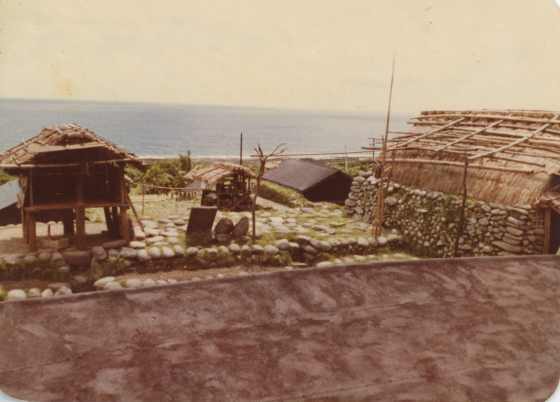
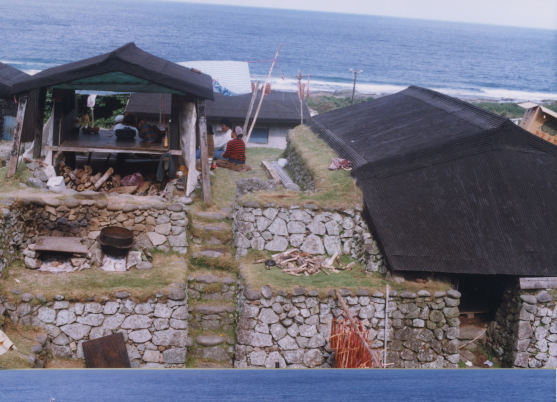
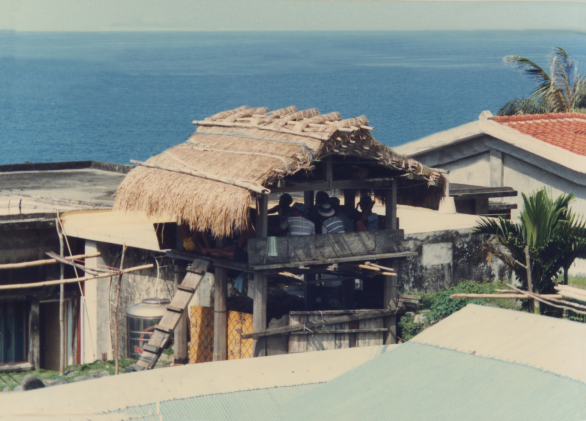
So (Sompo), Ma (Masaray), Mg (Magaga), Am (Father), In (Mother).
You may draw them as stick figures and place them in the correct areas of the porch.