Book 2 Lesson 6 | meyngen o ngepen (Tooth Ache)
meyngen o ngepen | Tooth Ache
Because of a long history of chewing betel nut, Si apen Magaga (Pg) had four broken teeth. The pain was so severe that her daughter, Si inan Magaga (Mg), took her to have the teeth removed. They are now waiting to have false teeth put in.
Readings
When can they put in my false teeth?
The dentist said two more months.
That long?
Yeah. It's your own fault for chewing betel nut. Look, your teeth were breaking one by one.
They didn't break from betel nut—it was from the meals.
Oh, the dentist washed your teeth so clean.
No—what are you talking about?
Really! They used to be as dark as coal, and now they are white and shining.
If I get false teeth, can I continue to chew betel nut?
If you say “I want to chew betel nut,” then I won't let you get false teeth.
How can I live without chewing betel nut?
Twenty thousand dollars! Can you bring yourself to get them dirty?
Grammar | meyngen o ngepen (Tooth Ache)
(1) Inflection of pangay “put”
In Example (1), pangay-an “put something somewhere” is formed by combining the verb pangay “put” with the transitive suffix -an, which marks location. Its agent ta “we” is in the genitive case, and the patient ngepen ko “my teeth” is nominative.
In Example (2), pangay-i is an inflected form of pangay-an, triggered by the preceding auxiliary ji.
When will they put in my false teeth?
2. si “manmama ko,” koan mo am, ji ko rana pangay-i o ngepen mo.
If you say “I want to chew betel nut,” then I will not let you get false teeth.
(2) Inflection of panmama “to chew betel nuts”
manmama “to chew betel nuts” is the intransitive form of panmama. The initial m- consists historically of -om- + p-.
In Example (4), manmama appears after the auxiliary ji, and the initial p- becomes m- due to nasal assimilation.
The form ikamamaen contains the prefix ika-, which expresses “reason for…”. mamaen is composed of mama “chew” plus the transitive suffix -en, meaning “something chewed” → “betel nut.”
If you say “I want to chew betel nut,” then I will not let you get false teeth.
4. a maviay ko a ji rana manmama.
How can I live without chewing betel nut?
5. ta ikamamaen na, beken a kanen o ya na nikapodpod a.
They didn't break from the betel nut. It was from the meals.
6. nonan, kapanmama mo, manngo ori,
Yeah. It's your own fault for chewing betel nut.
7. si pangayan rana o ngepen ko am, apia o kapanmama ko rana?
If I get false teeth, can I continue to chew betel nut?
(3) mika- “gradually; one after another”
When mika- attaches to a reduplicated root, it indicates that an action happens gradually or repeatedly one after another. Other examples include: mika-za-zakat “all died one after another” and mika-yoka-yokay “all woke up one after another.”
The teeth were breaking one by one.
(4) maka- with numbers
When a number word functions as a verb, it must take the prefix maka-. The question word for numbers pira also follows this pattern.
The dentist said, “Two more months.”
10. ya rana maka-pira vehan a, kakeykeykai na mamno?
How many months have they been planted? (implying they grow too fast)
(5) Verb inflection after to and ji
Examples (11)–(12) are intransitive verbs; (13)–(14) are transitive. mancian is derived from i-panci. ngbeywani comes from ngbeywan-an, whose initial vowel was deleted due to lack of stress.
Oh, the dentist washed your teeth so clean.
12. nonan, akmi zateb nokakoa sio am, siciaikoa ya am, ya to maniray.
Really! They were as dark as coal before, and now they are so white they shine.
13. to mancian.
No, what are you talking about?
14. mo ji ngbeywani o adoa laksa a loiten mo.
Twenty thousand dollars! Can you bring yourself to get them dirty?
Demonstrate | meyngen o ngepen (Tooth Ache)
(1) Dialogue practice: Dental check-up
One student plays the dentist and asks the patient what happened to his/her tooth. Practice using vocabulary such as “broke” and “fell out.”
What happened to your tooth?
B: ya nimakteb o ngepen ko.
My tooth broke.
A: ikong na nikakteb?
Why did it get broken?
B: ya nimakteb no kalektek ko.
It broke when I fell down.
A: ya makongo o ngepen mo?
What happened to your tooth?
B: ya mapodpod o ngepen ko.
My tooth fell out.
A: ikong na ikapodpod?
Why did it fall?
B: ko mangos am, ya toda apodpod o ngepen ko.
It fell when I ate sugarcane.
(2) Role play: Teeth cleaning (hygienist + elderly + daughter)
The hygienist (A) complains that the old woman's teeth (B) are as dark as coal because of betel-nut chewing, and tells her that cleaning will take several sessions. After finishing, the daughter (C) comments on how shiny the teeth look.
Your teeth are as dark as coal!
B: oyó-od? veraen mo pa o ngepen ko an?
Really? Could you clean my teeth?
C: wo, kagwa, ta ya to zézak o ngepen mo.
Wow! Your teeth are shiny.
B: to mancian (to gálagal).
Yeah, right! (Nonsense.)
(3) Role play: Installing dentures & warning against betel nut
The dentist (B) is ready to install dentures for the old woman (A), who still wants to chew betel nut. She even has her betel-nut knife ready. Her daughter (C) worries she will have to pay for another costly set of dentures soon.
When can I chew betel nuts again?
B: kakeykaian na saon o kakteb do awan am.
Six months at the earliest.
A: ay, kahahay na? maviay ko a ji manmama?
Oh, that's too long! How can I survive without chewing betel nuts?
C: si manmama ka am, ji ta pangayi o ngepen mo.
If you chew betel nut, we won't let you have false teeth.
B: ji ka na manmama, ta ikarahet na no ngepen mo.
Don't chew betel nuts—it's bad for your teeth.
Exercise | meyngen o ngepen (Tooth Ache)
(1) Cultural study: Betel nut in Yami society
Research the meanings and social functions of betel nut in Yami culture (e.g., rituals, hospitality, work breaks, social interactions). Compare how betel nut is used in Orchid Island society and in Taiwan. Present your findings with both pictures and written explanations.
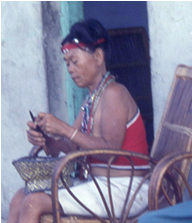
• Who chews betel nuts? When and why?
• Ritual purposes, taboos, gift-giving, or work-related uses
• Comparison with Taiwan: groups, occasions, cultural differences
• Include at least 2–3 photos with short captions (Yami + English)
(2) Health campaign poster
Research how chewing betel nut affects one's health (e.g., oral cancer, tooth damage, gum problems, staining). Create a health awareness poster to campaign for reduced betel-nut chewing. Use both Yami and English in your title.
• Title (Yami + English), e.g., ji manmama! / “Chew less betel nut!”
• Three key health risks
• Two suggested alternatives (e.g., chewing gum, drinking water)
• Contact or support information (school health office, clinic, etc.)