Book 3 Lesson 10 | kankanen no mamili so kanen (Pregnant Women's Food)
Si Misang (Mi) asked her mother about what people needed to pay attention to during pregnancy in traditional Yami culture.
What fish can't pregnant women eat?
You can't eat aporon fish because the child's head will become flat; or koskosi fish, or the child will cough easily.
What about the pregnant woman's husband?
He cannot eat keketan fish, or the child will have stripes on its neck.
How many months into pregnancy do you begin making the stomach bib?
Six months in, you begin making the stomach bib. The midwife massages the woman and fits the bib on her. Then the husband cuts bamboo.
What is the bamboo for?
It is for making a baby's crib and the staff for postpartum women, called sesngahan.
What do you give the midwife as payment?
Taro and fish; if not available, pork or lamb is fine.
What does a postpartum woman eat?
They may eat meat; four months after birth, they can eat taro leaves, koskosi fish, escargots, etc.
Grammar | kankanen no mamili so kanen (Pregnant Women's Food)
(1) yakan “side dishes, non-staple food”
Yakan “side dishes, non-staple food” is derived from the root kan “eat.” It may function as a noun meaning “side dishes” or as a verb meaning “to eat something as a side dish” (Examples 1–2). It may also form new words such as ipiyakan “can start eating side dishes” (Example 2), ji miyakan “cannot eat” (Example 3), and ji yakanan “reason for not being able to eat” (Example 4).
“What does a woman who recently gave birth eat?”
2. viniay o yakan da, no ikapat da vehan rana am, ori o ipiyakan da rana so cinapay, a ka no koskosi a ka no peyret sira.
“They can eat meat; four months after the birth they can eat taro leaves, koskosi fish, escargots, etc.”
3. o mehakay na am, ji míyakan so keketan, ta makagegetget so zagaw.
“Her husband cannot eat keketan fish, because the child would have stripes on its neck.”
4. íkongo o ji da yakanan a among no mamili so kanen?
“What fish can't pregnant women eat?”
(2) maka- “will cause, become”
The prefix maka- forms intransitive verbs expressing potential or causation. The root undergoes CV-reduplication, reducing intensity (“a bit”) or expressing frequent actions. Examples: makatatapi “become flat,” makapapala “cough easily,” makagegetget “have stripes.”
“You can't eat the aporon fish—the baby's head will become flat. You can't eat koskosi fish either—the baby will cough easily.”
6. o mehakay na am, ji míyakan so keketan, ta makagegetget so zagaw.
“Her husband cannot eat keketan fish—the baby will have stripes on its neck.”
(3) Ordinal number ika-
Ordinal numbers are formed by prefixing ika- to numerals or nouns. Examples include ikapira “how many months,” ikanem “the sixth,” and ikapat “the fourth.”
“How many months into pregnancy do you start making the stomach bib?”
8. no ikanem am, ori o ipangtekteb rana so awaz.
“Six months in, you start to make the stomach bib.”
9. viniay o yakan da, no ikapat da vehan rana am, ori o ipiyakan da rana so cinapay, a ka no koskosi a ka no peyret sira.
“They can eat meat; four months after the birth they can eat taro leaves, koskosi fish, escargots, etc.”
(4) Sequential construction ka- “and then”
The prefix ka- indicates a sequential event. It forms a nominalized structure requiring the Agent in Genitive case. Other arguments may appear in Oblique/Locative depending on the verb.
“Six months in, the bib is made; then the midwife massages the belly and fits the bib. Then the husband cuts the bamboo.”
Activities | kankanen no mamili so kanen (Pregnant Women's Food)
(1) Game 1 — “Scribble Game”
Students match fish names with (a) the identity of the person who eats them and (b) the traditional consequences of eating them. They discuss whether it is culturally appropriate for each identity group (pregnant woman, husband, postpartum woman) to eat each type of fish.
(2) Game 2 — “Pregnancy Ritual Calendar”
Students create a calendar marking the important months during which required rituals must be carried out by the pregnant woman's husband. Tasks include preparing the stomach bib, cutting bamboo, making the baby crib, and preparing ritual offerings.
Demonstrate | kankanen no mamili so kanen (Pregnant Women's Food)
(1) Game I — “Scribble Game”
Match the names of fish with the identity groups who intend to eat them, and discuss whether it is culturally appropriate for each group to eat each type of fish.
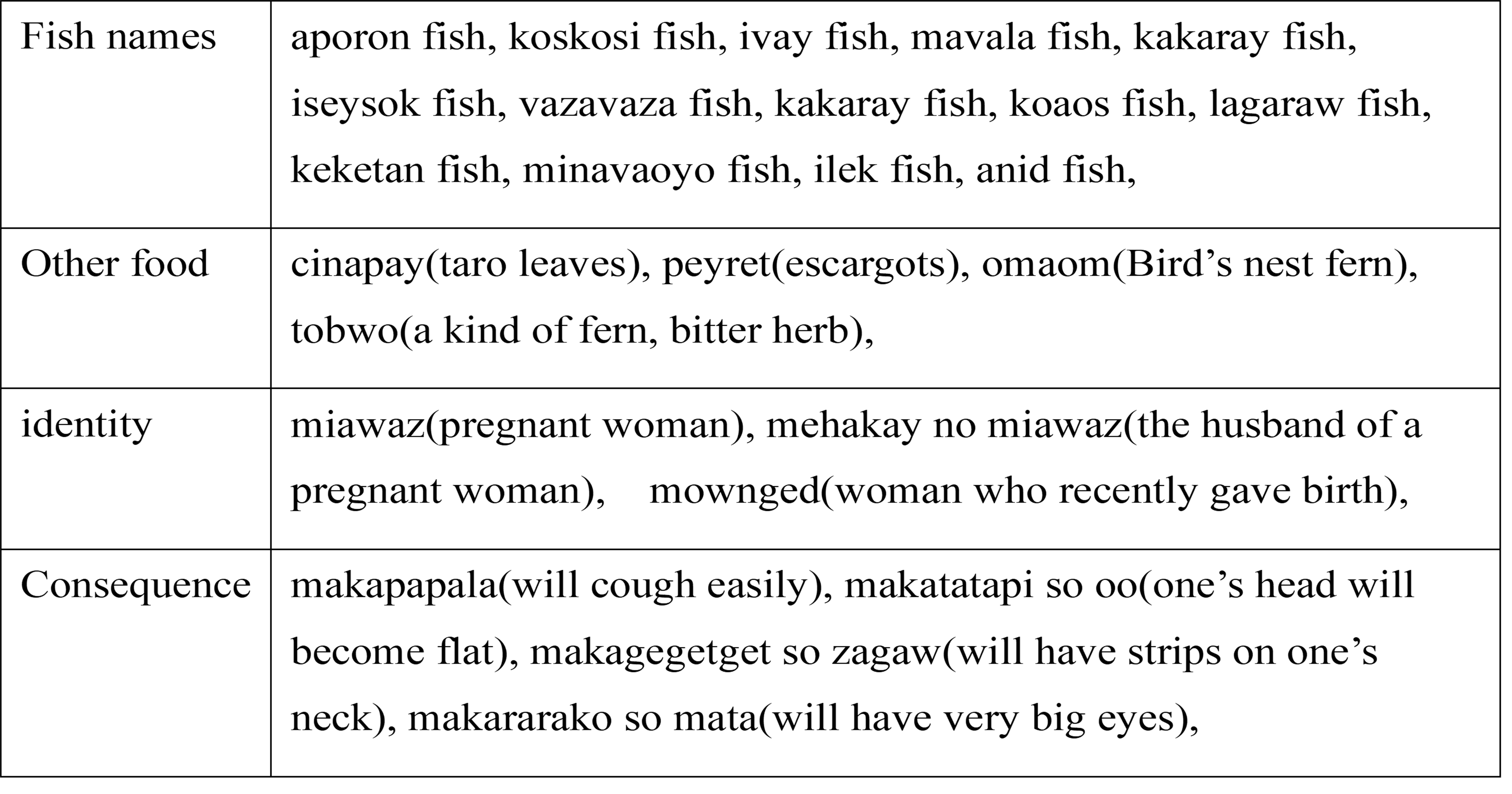
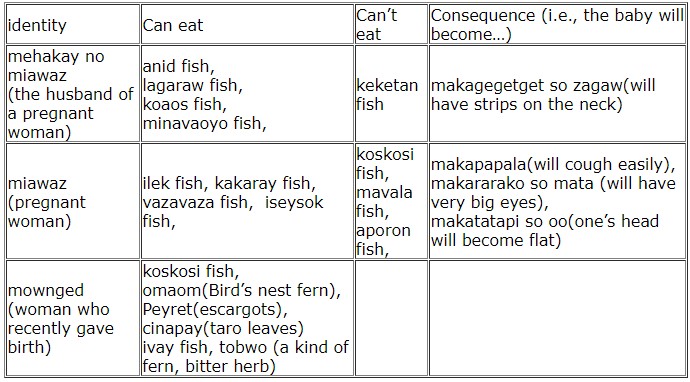
Dialogue 1
“Can a pregnant woman's husband eat keketan fish?”
B: beken, ji alahet.
“No, he can't. It's bad.”
A: ta ikong o ikarahet na?
“Why is it bad?”
B: makagegetget so zagaw.
“The child would have stripes on its neck.”
A: apia miyakan so koyta o mehakay no mamili so kanen?
“Can a pregnant woman's husband eat octopus?”
B: taon, ta ko katenngan.
“I don't know. How should I know?”
Dialogue 2
“What fish can't a pregnant woman eat?”
B: ji angan so aporon.
“She can't eat aporon fish.”
A: ta ikong?
“Why not?”
B: makatatapi so oo.
“The baby's head will become flat.”
A: ikongo pa o ji da yakanan a among?
“What other fish can't she eat?”
B: ji angan so koskosi, ta makapapala.
“She can't eat koskosi fish, or the baby would cough easily.”
A: a ka no ikongo pa?
“What else?”
B: ji angan so mavala.
“She can't eat mavala fish.”
A: a makakokongo o ri?
“What would happen?”
B: makararako so mata.
“The child's eyes will become very big.”
Dialogue 3
“What does a woman who recently gave birth eat?”
B: viniay a ka no cinapay am, peyret am, koskosi sira.
“They can eat meat, taro leaves, escargots, koskosi fish, etc.”
A: no mango am, miyakan sira so cinapay?
“When can she eat taro leaves?”
B: ala kavik sira do vehan.
“About half a month after childbirth.”
A: no mango am, miyakan sira so peyret?
“When can she eat escargots?”
B: no maparekmeh rana sira.
“Not until she can take a cold bath.”
A: no mango am, miyakan sira so ivay a ka no koskosi?
“When can she eat ivay fish and koskosi fish?”
B: no kasa vehan rana sira.
“One month after childbirth.”
(2) Calendar Preparation Game
Students create a pregnancy calendar marking the months in which husbands must perform childbirth-related rituals such as preparing bamboo, cutting the bedplate, or paying the midwife.
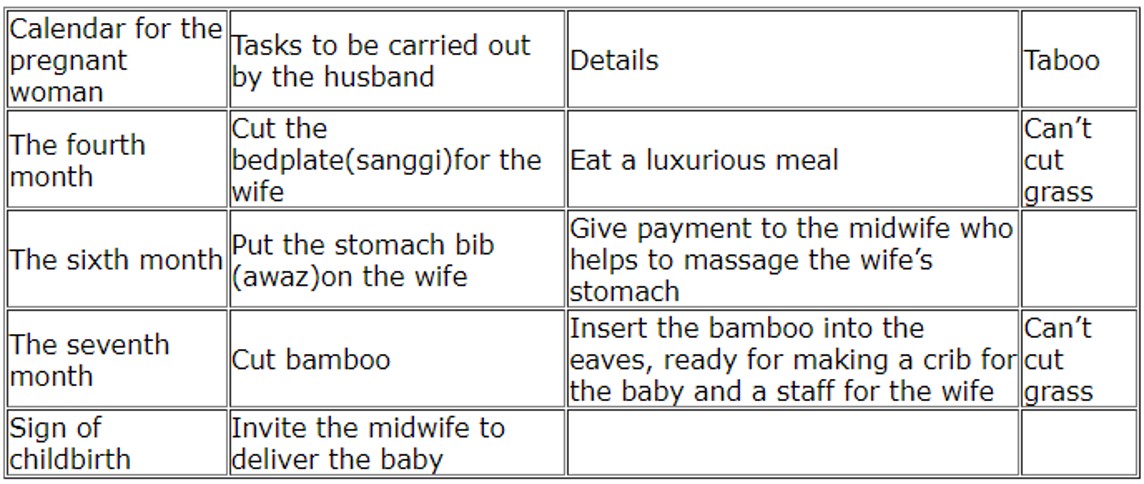
Dialogue — Husband Asking His Father
“When should I cut the bedplate?”
B: si ikapat na vehan am, mi ka manba.
“Four months in, you begin cutting.”
A: no mango am, mangtekteb so awaz na?
“When do you start making the stomach bib?”
B: no ikanem na vehan am, mangtekteb.
“Six months in.”
A: no mango am, manba ko so kawalan?
“When should I cut the bamboo?”
B: no ikapito na vehan.
“Seven months in.”
A: no mango am, ipanci ko o mangdes?
“When do I call the midwife?”
B: no maliliw na rana o kataotao na am, mi mo ipanci.
“When she feels the signs of childbirth.”
Exercise | kankanen no mamili so kanen Pregnant Women's Food
(1) Draw a simple chart to describe the process of preparing for childbirth in Yami culture. Your chart should include major steps such as: making the stomach bib (awaz), massaging the belly, preparing bamboo, making the baby's crib (lolay), and inviting the midwife.
(2) Write an essay of about 200 words explaining how to prepare for childbirth in Yami culture. Your essay should summarize the traditional procedures, including the roles of the pregnant woman, her husband, the midwife, and the cultural purposes of objects such as the stomach bib (awaz), bamboo, and the sesngahan staff.
You may consult the following references:
- Traditional Yami Wedding Ceremonies, paper presented at the 2004 Conference on Studies of Orchid Island
- Traditional Yami Childbearing, paper presented at the 2003 Conference on Studies of Orchid Island
- https://www.ioe.sinica.edu.tw/WebTools/FilesDownload.…
- https://www.youtube.com/watch?v=t0OvMK8HJI8
- https://www.namr.gov.tw/ebook/1120324-02/index.html#p=304