Book 3 Lesson 8 | nikaroan da a rarakeh — Being Left Behind
Two young people, Sekez (Se) and Sidongen (Si), rowed out in their boat to play. They met an old person (Ra) who wanted to take advantage of them to get a free ride to Jiahaod to fish. Then, they rowed off and left the old man stranded.
Hey children, come over here for a second.
Hey, the old guy is calling us. Let's go see what he wants.
Move your boat over here and let me get in. Let's go to Jiahaod to fish.
Really?! Should we go? Sure, we've never been there before.
Ugh, this old man is so heavy—I feel like pushing him into the sea.
Grandpa, we're at Jiahaod now. You can get off.
Hurry, let's get away. He didn't help row at all and made us exhausted.
Yeah, let's go before he gets back into the boat.
Hey kids, you're just leaving? Aren't you going to take me back?
We don't care! You're annoying! You never row!
What will I do? The island is far! How can I swim back, children?!
It's your fault. You're the one who wanted to go to Jiahaod.
Hey brats! Come back and get me, you're so mean!
He deserves it—it's his own doing.
Grammar | nikaroan da a rarakeh (Leaving an old man stranded)
(1) Causative pa-
The causative prefix pa- can be added directly to a stative or dynamic verbal root to increase the degree of transitivity of a verb. Pa-sngen “cause to be close” is derived from the stative verbal root –sngen “close, near”, as in Example (1). No other affixes are added to the root because pa-sngen is an imperative form (see Table 5, Yami pivot, mood and aspect morphemes). The agent does not usually occur in imperative sentences unless used for emphasis; in that case, the nominative pronoun, e.g., kamo “you”, must be used rather than the genitive form.
The word ka-pa-zagpit “then give a ride to …” in Example (1) is formed by first adding the causative pa- to the root zagpit “step”, followed by adding the sequential prefix ka- to the stem pa-zagpit.
In Example (2), the patient of pa-'okso-en “push, cause someone to jump” is o rarakeh “the old man”.
Move the boat over here and let me get in. Let's go to Jiahaod to fish, shall we?
2. ay, ya teymasagpaw o rarakeh ya, inaoy no pa'oksoen do wawa.
Oh, this old man is so heavy. I really want to push him into the sea.
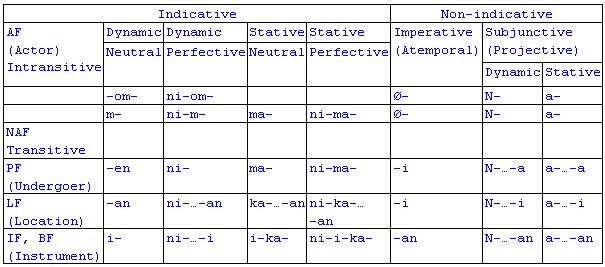
(2) tey- “too, very”
tey- “too, very” can be added directly to a stative root (Example 3) or a stative verb stem (Example 4). The word stress falls on the syllable immediately following tey-.
Hey, brat! Come back and pick me up! You are so bad!
4. ay, ya teymasagpaw o rarakeh ya, inaoy no pa'oksoen do wawa.
Oh, this old man is so heavy. I really want to push him into the sea.
(3) Bound Pronouns used as free pronouns
In principle, only free pronouns may appear at sentence-initial position. However, as shown in Example (5), the bound pronoun kamo “you” is moved to the clause-initial position to indicate proximity. When a bound pronoun is placed after the verb of a sentence or after an auxiliary, the tense of the sentence becomes future, as seen in Examples (6) and (7).
Hey, kids, why are you leaving? Aren't you going to give me another ride?
6. to kamo rana angay!
You can go first.
7. ji nio na ngahapa yaken?
Aren't you going to give me another ride?
Activities | nikaroan da a rarakeh (Leaving an old man stranded)
(1) Role play
Students take the roles of the two teenagers (B & C) and the old man (A), and act out the play based on the story.
(2) Game — “One by one”
Students create a new ending to this story. Each student contributes one sentence, and the teacher writes all contributions on the board.
Demonstrate | nikaroan da a rarakeh (Leaving an old man stranded)
(1) Role play demonstration
Hey, children, come over here for a second.
B: íkongo mo raran jiamen?
Why did you call us?
A: mi takamo do Jiahaod an?
Let's go to Jiahaod, OK?
B: wo, to závak o mangay do Jiahaod ang, mi ta an,
Oh, it's a rare chance to go to Jiahaod. Let's go there, OK?
C: nohon; sákay jito, mo akay.
OK, get on our boat, Grandpa.
B: ay, ya manzíkna o rarakeh ito a ya teymásagpaw,
Oh, it's tiring. This old man is so heavy.
C: to ta na patovóza do wawa, mangazicin a ya ji mángaod,
Let's push him into the sea! He did not help us row. He is so annoying!
B: o ya rana Jiahaod! ágcin rana, mo akay,
Grandpa, here is Jiahaod. Get off our boat.
A: manga koinio! nio na ji ngapa yaken!
Hey, kids! Aren't you going to give me another ride?
B: apia pa jimo ori a ya jí mangaod, a namen ikazikna,
You brought it on yourself. You didn't row and made us very tired.
(2) Game — “One by one” sample ending
Hey, kids! I have delicious taro cake. Go ahead, eat it!
B: tosia, ta namen makcin.
No, we are not hungry.
A: oya so ranom, apey kamo, ta inomen nio.
I have water for you. Drink it!
C: tosia, ta namen mawaw.
No, we are not thirsty.
A: ipanta ko inio so teylilima poo a, yavang nio pa yaken an.
I will pay each of you 50 dollars to take me back, OK?
B: tosia, si teylilima namen a poo so ikadoa ranaw am ori i.
No, one hundred fifty each.
A: am beken a ya doa ranaw o nizpi ko, teysa ranaw kamo, an.
I only have two hundred dollars. One hundred each, OK?
B: ay, ya teymásagpaw o rarakeh ya, inaoy no ta jí niavang ori.
Uh! This old man is so heavy. I regret taking him back.
A: He he he, apia pa jinio ori, kamo teymákey no nizpi ya.
(Laughter) It's your own fault! You are too greedy.
(3) Debate practice
Divide the class into two groups and defend either the old man or the two teenagers.
The children really have no sympathy.
B: íya makey a mangay do Jiahaod am.
He's the one who wanted to go to Jiahaod.
A: am amian so to rana náid so rarakeh.
But they should not have left that old man there.
B: amian so mihanhan no kanakan a mangaod?
How can someone rely on small kids to row for him?
A: ya makarílaw o kanakan a ya mazíkna a mangaod,
Have pity on the kids! They were exhausted from rowing.
B: makarkarílaw pa o rarakeh a ya niomawat so pongso ta am.
Have pity on the old man who had to swim all the way back home!
Exercise | nikaroan da a rarakeh (Leaving an old man stranded)
(1) Writing: Short story
Read “Bye, Grandpa!” in Yami Texts with Reference Grammar and Vocabulary by Rau & Dong (2006). Try to rewrite it as a short story of approximately 200 words. (Link: https://www.ling.sinica.edu.tw/item/en?act=publish_book&code=view&bookID=80)
(2) Writing: Argument essay
Write an essay explaining who was at fault in the story “Bye, Grandpa!”. Support your argument with reasons from the story and your own judgment.