Book 3 Lesson 9 | manazang so yakan (Buying Vegetables)
The vegetable and meat vendor (Za) arrived in Iranmilek. Si nan Miaven (Ma) came to buy ingredients to prepare a feast for relatives returning home. She met Mivovo (Mi), who was also waiting for the vendor.
Is the vendor here?
I'm not sure; let's go see — maybe he arrived already.
What do you want to buy?
Do you have fresh fish?
Yes — how many?
Three fish.
Would you like pork or chicken?
Three hundred ninety.
Grammar | manazang so yakan (Buy the Vegetables)
(1) sazang “buy”
This section introduces various verb forms derived from the root sazang “buy.” The verb manazang is formed by combining the intransitive prefix maN- with the root sazang “buy,” as shown in Example (1). Its complement so viniay a ka no manok “pork and chicken” is marked by the oblique case marker so.
The transitive form is sazang-an “to buy,” whose negative form is ji nazang-i “not buy,” as seen in Example (3). The perfective form is ni-sazang-an “bought,” as in Example (4). In Example (5), pananazangan “the place one often buys from” generally refers to a store; in this lesson, however, it refers to the aleleh “truck.” Thus, o pananazangan so yakan a aleleh literally means “the truck one often buys vegetables from.”
“Do you want to buy pork and chicken?”
2. íkong mo sazaongan?
“What do you want to buy?”
3. wo, kasingasíngat na? tosia, ji ko nazangi.
“Oh, so expensive? Never mind then — I won't buy it.”
4. ápira o kalovotan na no ko nisazangan a yakan?
“How much do my groceries cost?”
5. ya na nimai o pananazangan so yakan a aleleh?
“Is the vegetable truck here?”
(2) ji “really, definitely”
The auxiliary ji expresses certainty or affirmation, often countering doubt. In Example (6b), ji ngian “Yes, definitely” confirms the presence of fish. In Example (7b), ji apia-a “definitely good” and ji aganinam “definitely sweet” negate the possibility that the oranges might be sour.
“Do you have fresh fish?”
6b. jí ngian, ápira o apen mo?
“Yes, we do — how many do you want?”
7a. ya mánlanget o vazacinok ya?
“Are these oranges sour?”
7b. ji apia-a, ji aganínam, ákan pala ya?
“They're good — very sweet. Try one.”
(3) Counting numbers, people/things, and money
In Book 1 Lesson 9, we learned how to count people, objects, time, and money. Here we review that system and add practice for larger numbers.
Counting cardinal numbers from one to ten in Yami:
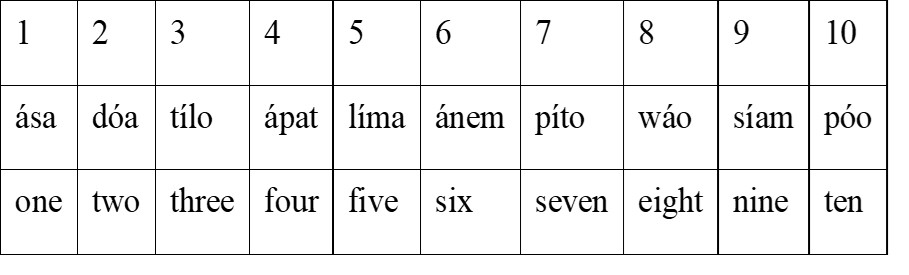
Numbers above ten follow the decimal system:
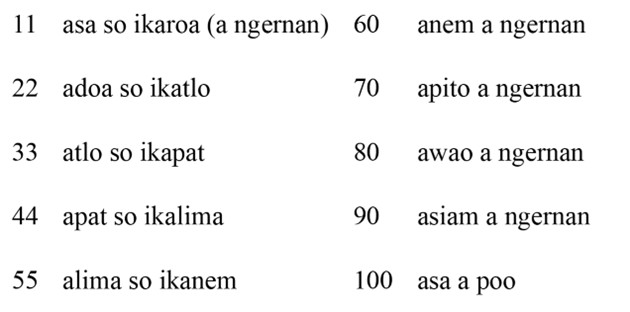
When counting people or things, the conjunction a ka follows the counted noun. Numbers from two to ten use Ca-reduplication, e.g., lalima a ka tao “five people.” Tens are linked with the copula a, e.g., kakasiaman a tao “ninety people.”
In this lesson, Ca-reduplication is not used when counting things. Examples:
“Three fish.”
9. pántan yaken so adoa aka opa no manok aka no apat a gagay a viniay.
“Give me two chicken legs and four slices of pork.”
For counting money, see Examples (10)–(11). Example (11) asiam a poo o ikapat na ranaw (“three hundred ninety dollars”) literally means “ninety of the fourth hundred.”
“Let me weigh it — one hundred dollars.”
11. ya asiam a poo o ikapat na ranaw.
“Three hundred ninety dollars.”
Activities | manazang so yakan (Buying Vegetables)
(1) “Shopping” Game
Draw various foods on paper cards, such as vegetables, fruits, chicken, duck, fish, and different kinds of meat, and label each item with a price. Students then take turns acting as shop owners and customers, practicing buying and bargaining using the expressions learned in this lesson.
(2) Valentine's Day Gift List
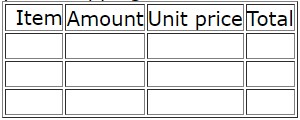
Make a list of presents you would like to buy for your lover on Valentine's Day, and calculate the total cost. You may include items such as a watch, flowers, cosmetics, accessories, or a romantic dinner.
Demonstrate | manazang so yakan (Buying Vegetables)
(1) “Shopping” Game
Draw various foods on paper cards such as vegetables, fruits, chicken, duck, fish, and meats, and label the prices. Students then act as shop owners and customers, practicing bargaining and price checking.

Example 1 — Buying Duck, Fish, Vegetables, Bananas
Do you have duck?
B: apira mo apen?
How many do you want?
A: kakteb na (no bibi).
A half.
B: ikongo pa o mo apen?
What else would you like?
A: among a ka no napa.
Fish and vegetables.
B: mangap ka so vineveh?
Do you want bananas?
A: nohon, asa sapad.
Yeah, one bunch.
B: ya pa mian so mo apen?
What else do you want?
A: ji abo rana, ya apira o ngina no bibi?
No thanks. How much is the duck?
B: ya asa a ranaw.
One hundred dollars.
A: ya apira o ngina no among?
How much is the fish?
B: ya alima poo o ikadoa na ranaw.
One hundred fifty dollars.
A: ya apira o ngina no napa?
How much is the vegetable?
B: ya atlo a poo.
Thirty dollars.
A: ya apira o ngina no vineveh?
How much are the bananas?
B: ya alima ngernan o ikapito na poo.
Sixty-five dollars.
A: ya apira o na kalovotan?
How much is the total cost?
B: ya alima ngernan o na ikalima poo o na ikapat a ranaw.
Three hundred forty-five dollars.
Example 2 — Buying Chicken, Sugarcane, Bananas
What do you want to buy?
B: ko manazang so manok.
I want to buy chicken.
A: apira o mo sazangan?
How many do you want?
B: asa (aka manok). Apira o ngina na?
One. How much is it?
A: apito a poo o ikadoa na ranaw.
One hundred seventy dollars.
A: manazang ka so onas?
Do you want sugarcane?
B: tosia, ta ji ko anget.
No, I cannot chew.
A: manazang ka so vineveh an?
Do you want bananas?
B: am ya ji ateyáro rana o ito.
But that bunch is too much.
A: kakteb na an.
How about half of it?
B: nohon, apira ngernan?
Ok. How much?
A: atlo a poo.
Thirty dollars.
A: ya apira o na kalovotan?
How much is the total cost?
B: ya adoa a ranaw.
Two hundred dollars.
(2) Valentine's Day Gift Budgeting
Students list the gifts they want to prepare for Valentine's Day and calculate the total amount of money needed. (See image below)

How much did you spend today?
Boy: vilangan ko pala an, ya anem a ranaw o ya na ikapito a zivo.
Let me figure it out. Six thousand six hundred dollars in total.
Girl: ya apira o ngina no toki ya?
How much is the watch?
Boy: ya atlo a zivo.
Three thousand dollars.
Girl: ya apira o ngina no kicibizo ya?
How much is the lipstick?
Boy: ya wao a ranaw.
Eight hundred dollars.
Girl: ayoy o nakem mo jiaken.
Thank you for your kind thought.
Girl: o ya am, ko itoro jimo a pangayan so nizpi.
This is the billfolder I gave you as a present.
Boy: ayoy!
Thank you.
Exercise | manazang so yakan (Buying Vegetables)
(1) Make a shopping list for your family to buy groceries for the New Year’s Eve, including what to buy and how much for each item.
(2) Based on the market price, please estimate the prices for the various foods on your shopping list, and calculate the total price.